Why Ad Funnels Pass Moderation in Tests but Break at Traffic Scale
A Test Doesn’t Show How the System Behaves Under Load
Most teams run into this problem the same way: the funnel worked in testing, passed moderation, metrics looked fine — and only after scaling do isolated rejections, group restrictions, and unstable results start appearing. The team begins swapping elements one by one and usually never finds the answer, because they’re looking in the wrong place.
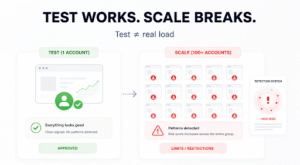
At test volume, the system sees an isolated snapshot: one account, one launch, one URL. No patterns — no reaction. The moment several accounts run the same campaign structure simultaneously, the analysis mode changes. The platform no longer evaluates individual elements — it sees the behavior of a connected network. And that’s where every mismatch that was invisible during testing starts to surface.
Scale doesn’t break funnels. It reveals hidden inconsistencies that were already there.
What Actually Breaks When Volume Grows
Three Signals That Don’t Exist in Testing
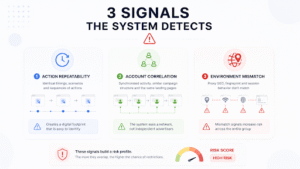
First — repetition. Identical launch timings, the same activation sequences, similar action patterns inside the ad account. This creates a behavioral fingerprint that’s impossible to make look random when operating dozens of accounts at once.
Second — account correlation. Synchronized activation with identical campaign structures and the same landing URLs — the system doesn’t read this as independent advertisers. It reads it as a coordinated network.
Third — environment mismatch. The proxy declares one GEO, the device fingerprint is atypical for that region, session behavior doesn’t match real users in that location. On one account — undetectable. On ten similar accounts — an anomaly the system accumulates as a risk signal across the entire group.
What This Looks Like in Practice
A typical scenario: a team runs stably on 40–50 accounts, moderation doesn’t react. They decide to scale to 300+ accounts over a short period. By day three or five — group restrictions hit 20–30 accounts at once, with no obvious individual violations. The team swaps the white page, then the proxies. Results stay unstable.
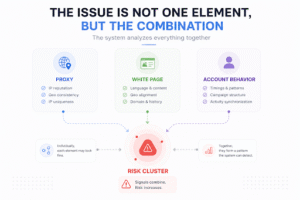
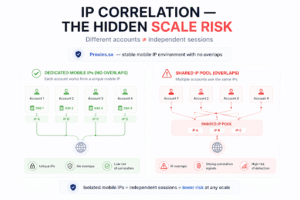
What happened: moving to 300+ accounts made the patterns statistically visible. The same IPs from one pool appeared across different accounts. One white page served all GEOs. Activation scenarios were identical. Each element individually — not a violation. All together — a clear signal of coordinated activity.
Where the Real Problem Is
The problem is almost never in a single element — it’s in the inconsistency of the entire chain.
| Element | Typical mistake | Symptom at scale |
| White page | One static page for all GEOs | Unstable results across regions |
| Proxies | IP overlap between accounts | Group-level restrictions |
| Accounts | Identical activation scenarios | Coordinated activity pattern |
Why the Proxy Layer Is Critical at Scale
Most solutions run on overloaded reseller pools where the same IPs appear across different accounts. At low volume, this is invisible. At 200+ accounts, the system reads IP correlations as direct evidence of a connected network and assigns risk scores to the entire group at once.
Infrastructure built on real SIM cards with daily IP rotation from carrier environments works differently. Each session gets an IP from a real mobile carrier environment — no overlap with other accounts, no shared history. In practice, this means scaling from 50 to 500 accounts while keeping network-level correlation between them minimal, because each session looks like an independent user. Proxies.sx builds this environment on its own modem farm without reselling — the IP overlap between accounts that becomes the primary trigger for group restrictions at scale is structurally eliminated here.
Why the White Page Breaks at Scale — and How to Fix It
During testing, a page is evaluated by its content. At scale, it’s evaluated in context: which devices open it, from which GEOs, how uniform the sessions are. A static page without regional adaptation creates signal mismatch: the proxy says one region, the page speaks to another, session behavior is identical across all markets. At low volume it passes. At hundreds of sessions per day — the system sees an anomaly.
White Link closes this layer: each market gets a page that matches its language and regional context. The result — reduced signal mismatch between the proxy environment and the content layer, fewer rejections as traffic grows, and moderation stability not just in testing but under real load.
How to Check a Funnel Before Scaling
- Is the white page adapted for each GEO — or is one page serving all markets?
- Are there IP overlaps between accounts at the proxy level?
- How similar are the account activation scenarios in timing and structure?
- Are early warning signals being tracked — dropping CTR, approval delays?
FAQ
Why doesn’t swapping the white page fix the problem? The white page is one signal among many. If the root cause is proxy correlations or account behavior patterns, changing the page won’t shift the picture. The entire chain needs to be consistent.
What does signal inconsistency look like in practice? The proxy says Germany, the device fingerprint is atypical for German mobile traffic, the white page is English-only. Each mismatch is a minor detail. Together they form an anomaly the system accumulates into the risk profile of the entire account group.
Why do problems appear specifically at scale? During testing, anomalies get lost in the noise. At scale they become statistically significant — and the system responds not to individual accounts, but to the entire connected group at once.
Conclusion
Scale doesn’t break funnels — it reveals what was already broken but invisible at low volume. Teams that understand this before scaling build infrastructure as a system: the white page is aligned with GEO, the proxy environment isolates accounts from each other, behavioral patterns don’t create visible correlation. When all layers operate consistently — the funnel stays stable not just in testing, but under real traffic load.
For those building this stack — promo code WELCOME15 gives 15% off the first order at Proxies.sx.