What to Choose for Dating Traffic in 2026

Dating remains a competitive vertical, where profitability depends not only on traffic quality but also on how effectively that traffic is monetized. One of the key decisions media buyers face is whether to send visitors to a specific offer or use a smartlink that distributes traffic across multiple campaigns. Direct offers provide control over the funnel, while smartlinks simplify distribution across GEOs and devices.
What Is a Direct Offer?
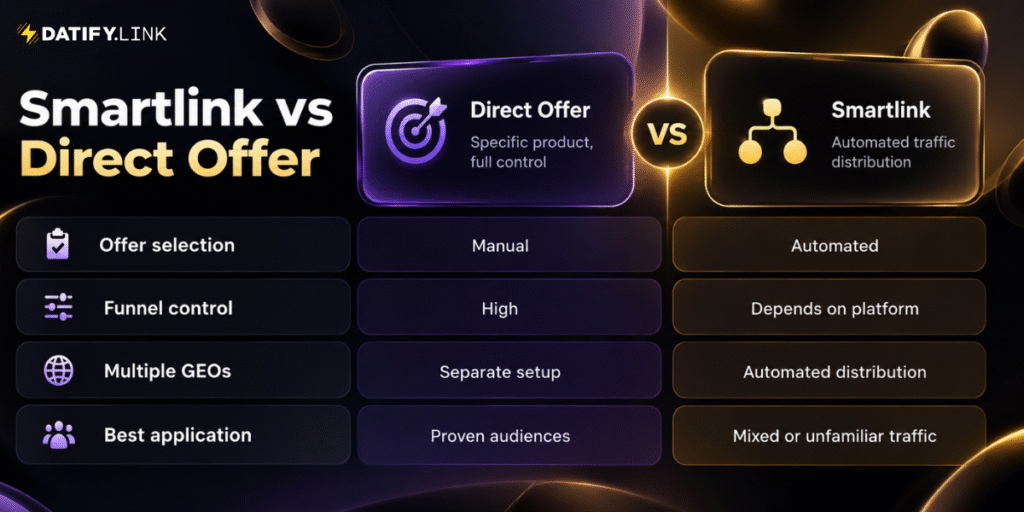
A direct offer promotes a specific product under predefined conditions: GEO, device, traffic source, payout model and conversion requirements. The media buyer builds the campaign around it, adapting creatives, targeting and pre-landers to the product. This gives control over the user journey, but testing several offers across markets requires extra time and budget.
What Is a Smartlink?
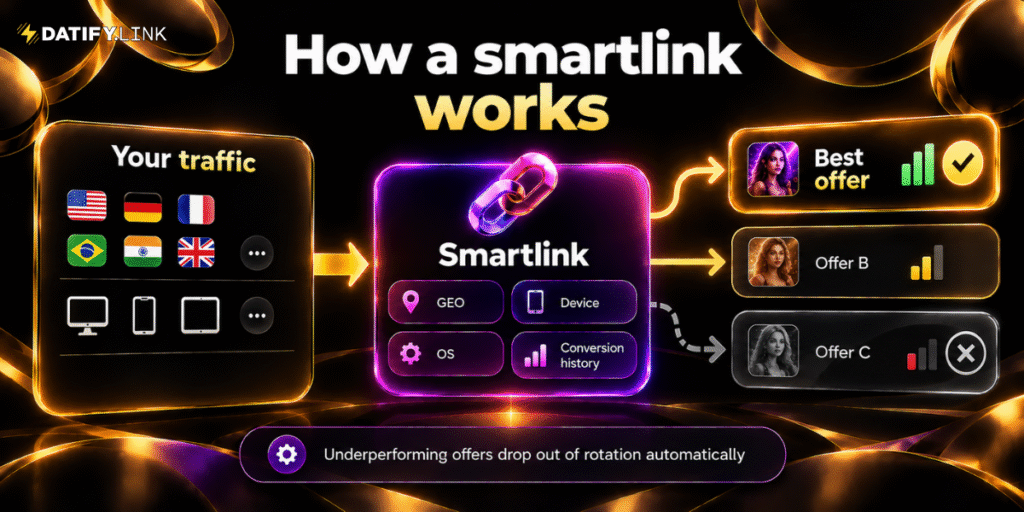
A smartlink is a single URL that distributes traffic among multiple eligible offers. Routing algorithms can consider GEO, device, OS, browser and historical conversion performance to decide which offer receives each click. This is especially useful for mixed traffic, where separate campaigns for every combination would require significant manual effort.
Testing Costs
Direct offers are tested individually, which gets expensive across multiple GEOs. Smartlinks reduce manual offer selection during initial testing, but automation does not eliminate ad spend or guarantee profit: conversion rate, EPC and acquisition costs still need analysis.
Control and Scaling
Direct offers work best when a profitable audience is found and the whole funnel can be optimized around one product, with individual rates negotiated for volume. Smartlinks offer more flexibility when expanding into new GEOs or working with diverse audiences.
When to Choose Each Model
Choose a direct offer when you know your audience, have a proven GEO and source combination, and need precise control over the landing page. Choose a smartlink for testing unfamiliar markets, managing mixed traffic or reducing manual offer management.
The Combined Strategy: Test, Compare, Optimize
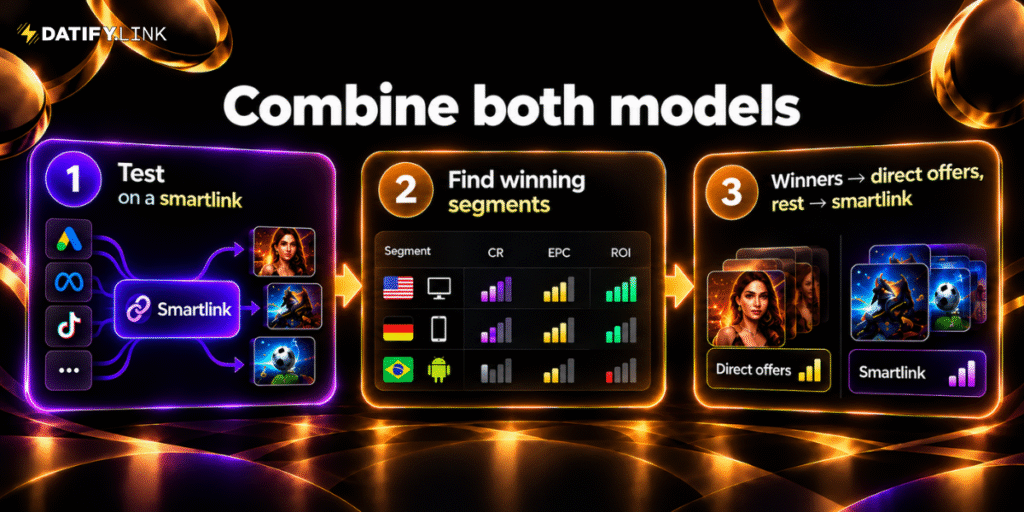
Experienced teams rarely choose one model exclusively: they explore traffic through automated routing and then focus on specific campaigns once enough data is collected.
How It Works in Practice
Stage 1. Identify Profitable Segments
Start with a controlled budget and collect statistics by GEO, device and source. Two metrics matter most:
EPC = Total Revenue / Total Clicks
ROI = (Revenue − Advertising Costs) / Advertising Costs × 100%
An offer paying $5 with a 2% conversion rate gives $0.10 EPC, while one paying $3 with 5% gives $0.15. Despite the lower payout, the second earns more per click.
Stage 2. Test Direct Offers on Strong Segments
Test suitable direct offers on profitable segments under comparable conditions. If a direct offer consistently outperforms the smartlink, give it more traffic; keep other segments on automated routing.
Applying the Strategy with a CPA Network
A network that supports both models simplifies campaign management. For example, Datify.Link offers smartlink monetization and 1,200+ offers across Dating, iGaming, Cams and Games. Its AI allocator distributes traffic and disables underperforming offers, and a personal manager helps pick campaigns for specific sources and GEOs.
Conclusion
Direct offers give control over proven campaigns, while smartlinks simplify distribution and market exploration. Combining both, with decisions based on EPC, ROI and traffic quality, is the most practical strategy. To try both approaches, register at Datify.Link.